


PM-AD04
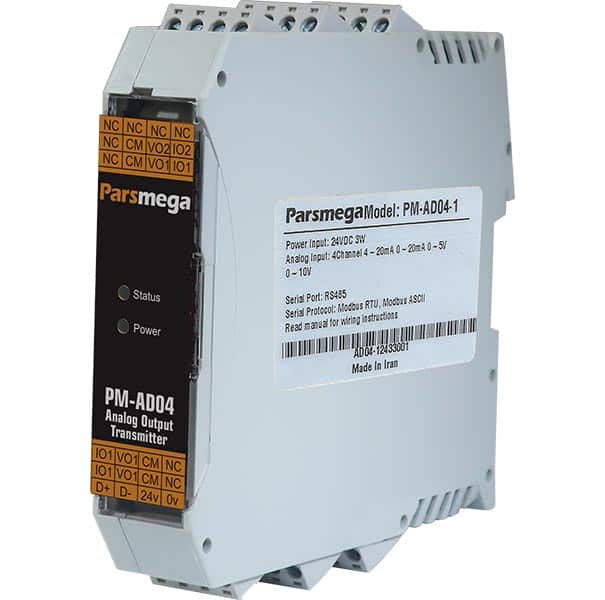
4 independent analogue output channels
 RS485 communication
 Modbus RTU communication
 Isolation
 Analogue output


For example, PM-LT12 or load cell transmitter
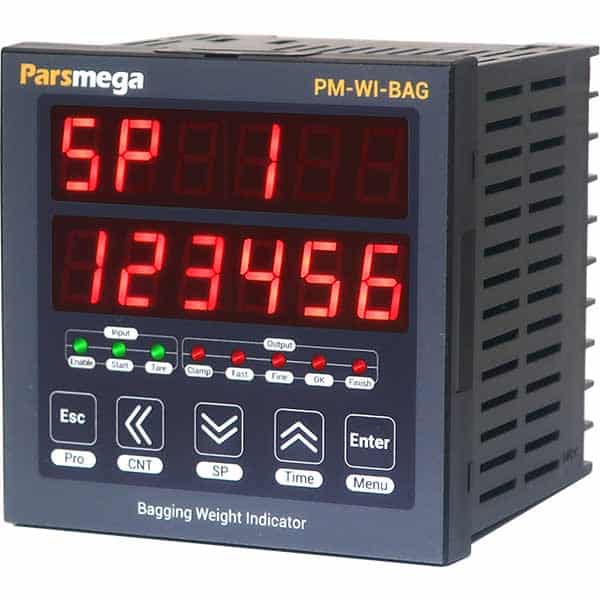
PM-WI-BAG
The PM-WI-BAG weighing indicator/controller is designed for bag filling of powders and granules and for drum and container filling. It reads up to six load cells with a 24-bit converter and has five relay outputs, an analogue output and RS485 Modbus.
RS485 communicationModbus RTU communication Relay outputAnalogue output
 Digital input
 Digital output
 18-month warranty
The PM-WI-BAG is a weight indicator and controller dedicated to two-stage bag-filling machines: powder and granule baggers, animal feed, chemicals and minerals, and drum and container filling. It reads the load cell signal with a 24-bit A/D converter and 1:100,000 resolution (one channel, up to six 350 Ω load cells in parallel) and runs the whole filling cycle without a PLC: bag clamp, fast feed, slow feed, weight check and end of cycle.
It works in two modes. In Bag mode (direct bag filling) the bag and clamp sit on the load cells and the weight is measured directly in the bag. In Bucket mode the material is first weighed in a weigh bucket and then discharged into the bag through a gate, which suits faster and more accurate lines.
Four parameters set the weight: Target (final weight), Bulk (fast-feed cut-off), Fall (compensation for material still in flight) and Tolerance (accepted range). For a 25 kg bag with Bulk at 23.5 kg and Fall at 0.05 kg, fast feed stops at 23.5 kg and slow feed at 24.95 kg. Once the weight settles, the OK output switches on if the weight is within tolerance.
Five independent profiles each keep all weighing settings for one product or bag weight. When the line changes from 10 to 25 kg bags or from powder to granules, the operator only switches the profile. Four timers, T Clamp, T Stable, T Drain and T Finish, tune the mechanical behaviour of the cycle separately from the weight parameters.
Five 5 A relays control the bag clamp, Bulk, Fine, OK (or the discharge gate in Bucket mode) and Finish. The Finish output drives a conveyor, a bag counter or signals the end of the cycle to a PLC. Three digital inputs, Enable, Start and Tar, take their commands from push buttons or machine sensors.
The top display row shows the live weight and the bottom row shows setpoints, messages and errors, while eight LEDs show the input and output status. The five front keys give shortcuts to profiles, the counter, setpoints and timers, and advanced parameters are password protected against accidental changes.
To send the weight to a control system it has a 16-bit analogue output (0–5 V, 0–10 V, 0–20 mA and 4–20 mA) and an RS485 port with Modbus RTU. To connect it to a PC, use the PM-US02 USB-to-RS485 converter.
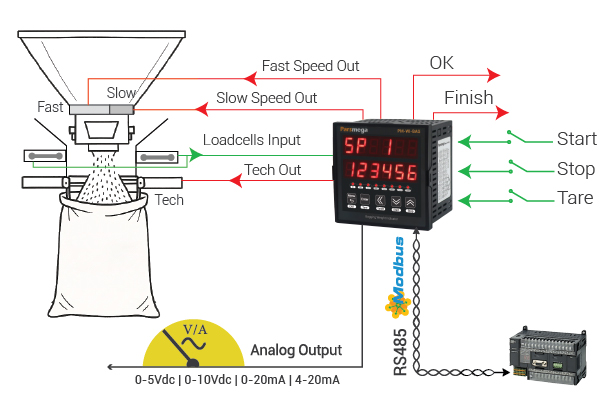
The diagram above still uses the older input names Start, Stop and Tare; on the current version they are Enable, Start and Tar.
In Bucket mode the same steps happen in the weigh bucket; after the weight is checked, the Drain output opens the gate for T Drain to discharge the material into the bag.
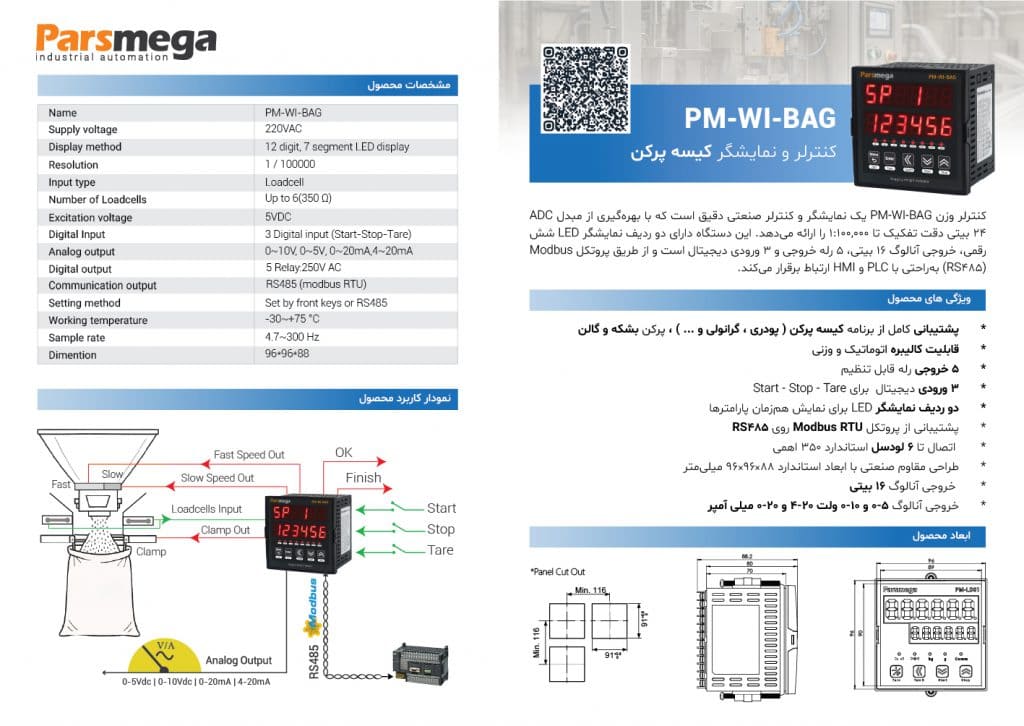
The current controller measures 96 × 96 × 89 mm. The image above shows the earlier datasheet. Refer to the specification table on this page for current dimensions and digital input names.
Note: use shielded cable for the load cell, earth the shield at the controller end only, and route the load cell cable away from power cables. For load cell wiring, read 4-wire vs 6-wire load cells.
Note: use a contactor or interposing relay for inductive loads such as large solenoid valves. On the RS485 network, use twisted-pair cable and a 120 Ω terminating resistor at the end of the line.
The PM-WI-BAG is built for the complete bag-filling cycle. If your process is different, see these models:
Compare all models in the weight indicator category. Parsmega's technical team can recommend a model and settings for your bag filler, capacity and line speed.
In Bag mode (direct bag filling) the bag and bag clamp sit on the load cells and the weight is measured directly in the bag. In Bucket mode the material is first weighed in a weigh bucket and then discharged into the bag through a gate. The relay logic and cycle sequence differ between the two modes.
Fall is the material still in flight after the Fine output switches off. The controller switches Fine off at Target minus Fall. If the final weight is above Target, increase Fall; if it is below, decrease it. Two or three test cycles are usually enough.
Five independent profiles. Each keeps its own Target, Bulk, Fall, Tolerance and other weighing settings, for example 10, 25 and 50 kg bags or powder and granules. Selecting a profile recalls all its settings.
Three digital inputs: Enable to enable weighing, Start to start the cycle (or clamp the bag) and Tar. Five relays: bag clamp, Bulk, Fine, OK (or bucket Drain in Bucket mode) and Finish to signal the end of the cycle to a conveyor, counter or PLC.
No. The controller runs the whole bag-filling cycle with its relays, from clamping the bag to finishing the cycle. If needed, it also connects to a PLC or HMI over RS485 with Modbus RTU or through its 16-bit analogue output.
Up to six 350 Ω load cells in parallel on one channel, with 5 V excitation and a sensitivity of up to 6 mV/V. Select load cell capacity and target weight to suit the controller’s measurement range and system design.
230 VAC.
18 months from the invoice date, with after-sales service for up to 10 years.
An English manual is not available for this product yet.

PM-AD04
4 independent analogue output channels
RS485 communicationModbus RTU communicationIsolationAnalogue outputPM-AD11
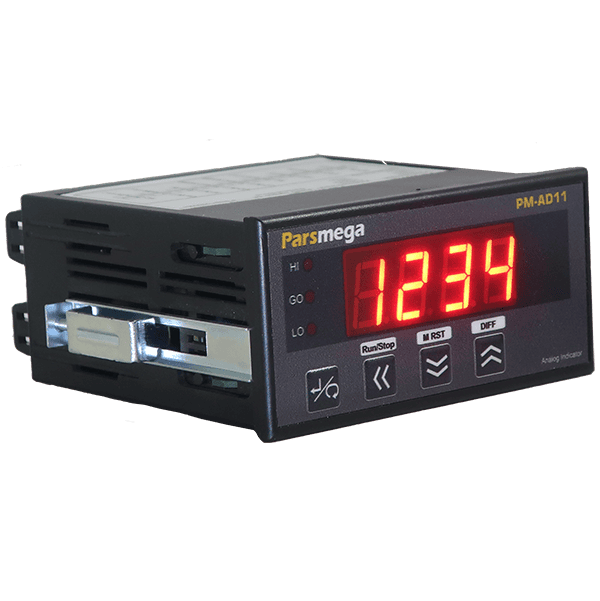
Analogue and resistive position sensor inputs; RS485 Modbus is the only output on this model.
RS485 communicationModbus communication Analogue input
PM-AD11A
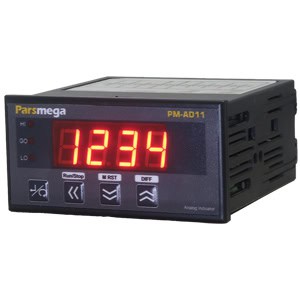
Analogue and resistive position sensor inputs, RS485 Modbus, three relay outputs and a standard analogue output.
RS485 communicationRelay outputIsolationAnalogue inputAnalogue output