


 Reading time: 4 min
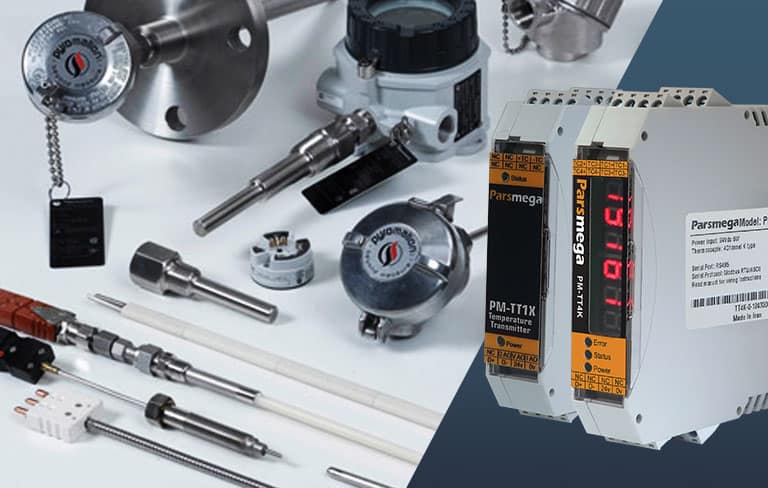
A thermocouple measures temperature using two dissimilar metals joined at a sensing junction. A temperature difference between the measuring and reference junctions produces a thermoelectric voltage that a suitable instrument converts to a temperature reading.
This simple, cost-conscious sensor is used across many industrial temperature-measurement processes.
How it works
The open-circuit Seebeck voltage depends on the metal combination and the junction temperatures. A thermocouple input instrument measures the voltage and accounts for the reference junction to calculate the measurement temperature.
Choosing a junction construction
Sheathed thermocouples are commonly offered with grounded, ungrounded or exposed junctions.

Grounded junction
The sensing junction is bonded to the protective sheath. Heat passes through the sheath to the junction efficiently, usually providing a faster response than an equivalent ungrounded design. Suitable constructions are used in liquids, gases and higher-pressure installations.
The electrical connection to the sheath can also make the measurement susceptible to ground-loop interference. Assess the instrument input and installation grounding.
Ungrounded junction
The sensing junction is electrically isolated from the sheath, commonly by magnesium oxide (MgO) insulation. This typically gives a slower thermal response but helps separate the low-level measurement signal from sheath-related electrical interference.
The sheath protects the junction. Suitability for a corrosive environment depends on the selected sheath material and construction.
Exposed junction
The junction projects beyond the protective sheath and is directly exposed to the medium. It can respond quickly, but is generally used in suitable non-corrosive, non-pressurised applications, such as gas temperature measurement where response speed matters.
Thermocouple types
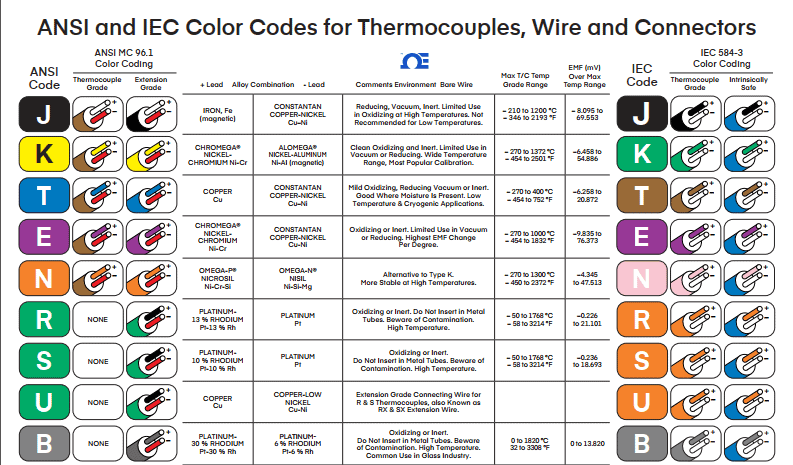
Different alloy combinations have different calibration characteristics. Common base-metal types include J, K, T, E and N. The source also discusses high-temperature types but contains a classification error: it groups C and an unclear “GB” designation with noble-metal types. Confirm the required standard type rather than relying on that grouping.
Accuracy and usable temperature range
Performance depends on the alloys, sensor construction, sheath, medium and installation conditions. Wire or sheath diameter can affect the usable temperature, especially for exposed wire and prolonged service.
Why type K is common
Type K combines a broad temperature range with practical durability and a long history of use. The source contrasts its alloy behaviour with copper-based type T and iron-based type J, and discusses sensitivity relative to T, J, E and N. Such comparisons depend on the operating temperature; choose from the actual calibration and application requirements.
Selection considerations
- Temperature: the source gives examples of type T use up to 370 °C and type K up to 1260 °C for appropriate constructions. These are not universal ratings for every probe.
- Wire size: the source contrasts type T #14 AWG wire (0.064 inch diameter) with #30 AWG wire, giving example limits of 370 °C and 150 °C respectively. Confirm the complete sensor rating.
- Tolerance: the source lists type T ±1 °C or ±0.75%, type E ±1.7 °C or 0.5%, and J/K/N ±2.2 °C or 0.75%, referring to ANSI/ASTM E230. These figures require verification against the applicable type, temperature range, grade and standard edition before use as a specification.
- Construction: consider sheath material, insulation and sensor geometry.
The Omega thermocouple reference guide provides construction- and wire-size-dependent reference data.
Thermocouple-grade and extension-grade wire
Thermocouple-grade wire is used to form the sensing portion. Extension-grade wire carries the signal from the probe to the reading instrument and generally has a lower permitted ambient temperature. It can carry a signal representing a high probe temperature without itself being exposed to that temperature.
Suitable thermocouple wire may be used for extension, but extension-grade wire is not a substitute for the sensing junction. Confirm the actual extension or compensating-wire designation; the source’s general “EX” prefix statement is not sufficient for identification.
Parsmega thermocouple transmitters
Compare the PM-TT4K and PM-TT1X product pages for supported thermocouple inputs, serial communication and model-specific measurement functions.