


 Reading time: 2 min
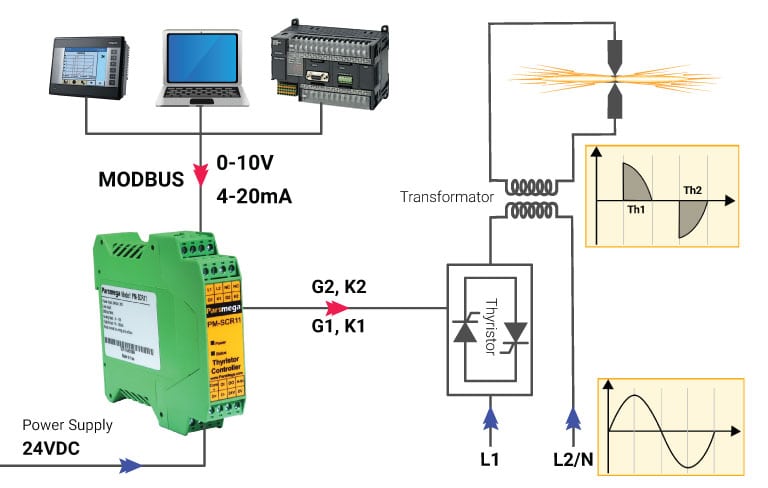
A thyristor power controller determines when a thyristor is triggered, adjusting its firing angle to regulate power. It provides an interface between a PLC or automation system and the power device.
A thyristor is a high-current semiconductor switch. A controller supplies the gate trigger pulses at the required points in the AC cycle. Depending on the design, the controller may include a gate drive, timing circuitry, voltage/current sensing, filtering and protection.
How it works
- A control system sends a demand signal, such as 4–20 mA or 0–10 V.
- The controller adjusts the thyristor firing angle according to that demand.
- The power stage delivers phase-controlled current to the load.
- The delivered power increases or decreases as the control demand changes.
Typical application areas
- Resistance welding, including spot welding and welded mesh production.
- Motor control in suitable AC/DC drive arrangements. Suitability depends on the motor and drive design.
- Controlled rectifiers, where AC is converted to an adjustable DC output.
- Industrial heaters and electric furnaces.
- Lighting dimmers designed for thyristor control.
- Suitable programmable power supplies and UPS power-control stages.
- Reactive power control in suitable power-system compensation equipment. The exact topology determines which switching technology is used.
Potential benefits include accurate power regulation, efficient high-load switching and long service life without moving switching contacts.
Parsmega PM-SCR11
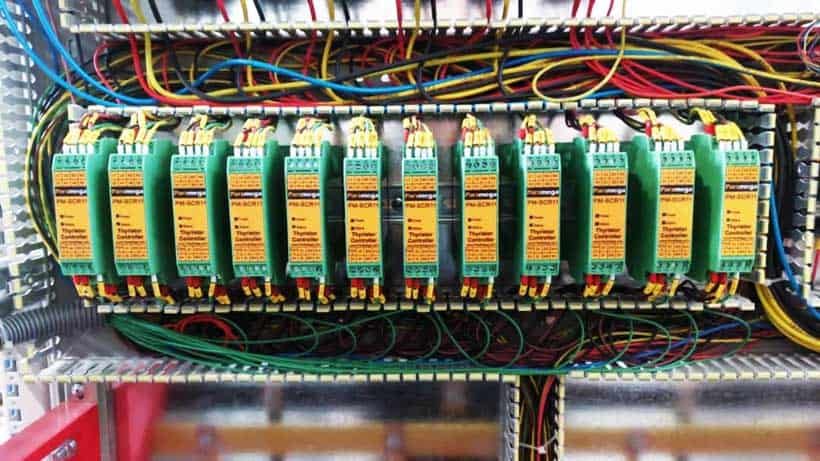
The photograph shows a Parsmega welding/thyristor controller used in mesh-making equipment.
The PM-SCR11 is described as a welding and firing-angle controller for industrial power applications. The source highlights:
- Industrial construction
- RS485 Modbus communication
- Two-stage control for resistance welding
- PLC control through 0–10 V or 4–20 mA demand signals
- Technical support and local repair services
- An 18-month warranty stated in the source
Open the product page for its catalogue and model-specific specifications.